R/O and Probable Diagnoses: How an Uncertain Dx Gets Coded
An outpatient "rule out" or "probable" diagnosis is never coded; the symptoms are. At hospital discharge the same words are coded as if the diagnosis were confirmed.

A diagnosis written as “rule out,” “probable” or “suspected” is coded two different ways depending on where the patient is. In an office visit or other outpatient encounter, it isn’t coded at all: the coder reports the symptoms, signs or test results instead. When a patient is discharged from a hospital stay, the same words are coded as if the diagnosis were confirmed. Both rules come from the official ICD-10-CM coding guidelines, and the split between them is spelled out in the guidelines themselves.
The words in the note
Clinicians use a small set of abbreviations for diagnoses at different stages of certainty:
| In the note | Means |
|---|---|
| Dx | Diagnosis: the condition identified as the cause of the problem |
| DDx | Differential diagnosis: the list of conditions still being considered |
| R/O | Rule out: a condition being tested for, to confirm or exclude |
| Working diagnosis | The best current explanation, held until more is known |
| Probable, suspected, likely | A diagnosis the clinician leans toward but hasn’t confirmed |
All of these describe the same reality: on the first visit, the cause often isn’t known yet. The coding guidelines say as much. “Diagnoses often are not established at the time of the initial encounter/visit,” the outpatient section notes. “It may take two or more visits before the diagnosis is confirmed.”
The outpatient rule: code what is certain
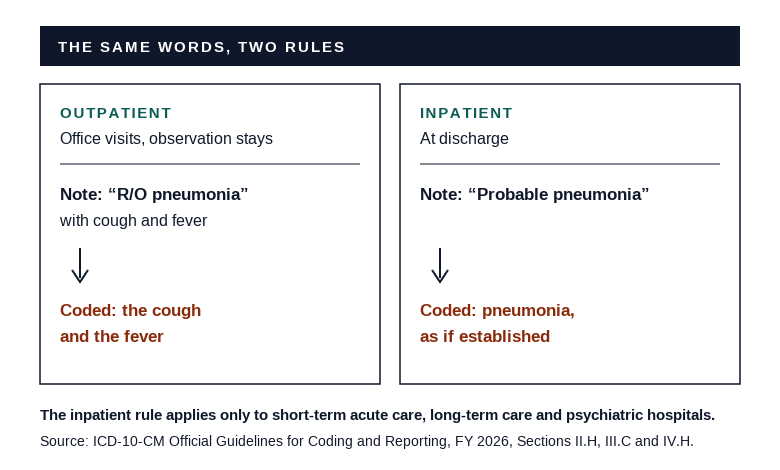
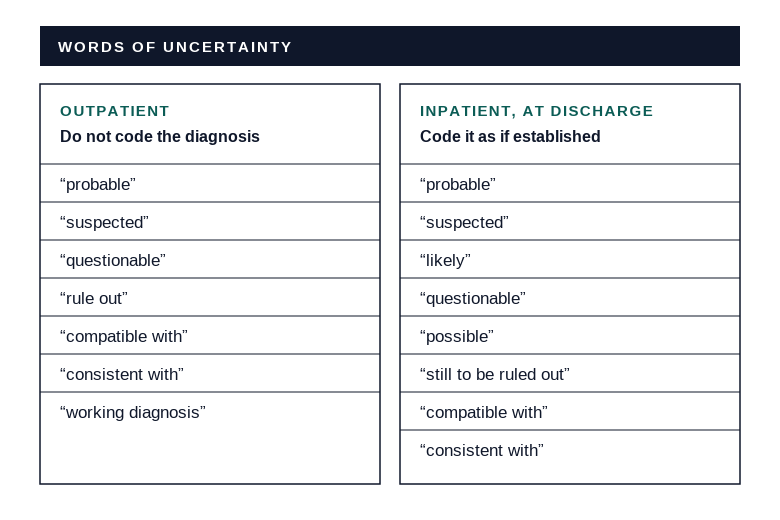
Section IV of the guidelines covers hospital outpatient services and office visits, and its rule on uncertain diagnoses is short. Do not code diagnoses documented as “probable,” “suspected,” “questionable,” “rule out,” “compatible with,” “consistent with” or “working diagnosis.” Instead, code the condition “to the highest degree of certainty for that encounter/visit, such as symptoms, signs, abnormal test results, or other reason for the visit.”
That’s why symptom codes exist in such numbers. The guidelines say codes for symptoms and signs, rather than diagnoses, “are acceptable for reporting purposes when a diagnosis has not been established (confirmed) by the provider,” and Chapter 18 of ICD-10-CM, codes R00 to R99, holds many of them.
So an office note that says “cough and fever, R/O pneumonia” is coded as a cough and a fever. If the chest x-ray comes back showing pneumonia, the pneumonia gets coded then.
Observation stays follow the outpatient section too. A stay in observation isn’t an inpatient admission, and the guidelines’ rules for observation stays sit in Section IV with the rest of outpatient coding.

The inpatient rule: code it as if it were confirmed
Hospital stays work the other way. If the diagnosis documented at the time of discharge is qualified as “probable,” “suspected,” “likely,” “questionable,” “possible,” “still to be ruled out,” “compatible with” or “consistent with,” the guidelines say to “code the condition as if it existed or was established.”
The reasoning is practical. By discharge, the guidelines explain, the patient has usually had the workup, the observation and the first treatment that go with the suspected diagnosis, so coding it reflects what the hospital actually did. The rule appears twice, once for the principal diagnosis (Section II.H) and once for additional diagnoses (Section III.C), and both times with the same limit: it applies “only to inpatient admissions to short-term, acute, long-term care and psychiatric hospitals.”
Test results follow the same split
Abnormal findings get the same two-track treatment. For an outpatient diagnostic test that a physician has interpreted, with the final report in hand, the guidelines say to code the confirmed or definitive diagnosis in the interpretation, and not to add the related signs and symptoms as extra codes.
In the hospital, abnormal lab, x-ray and pathology results aren’t coded unless the provider indicates their clinical significance. If a result is outside the normal range and the provider has ordered more tests or treatment for it, the guidelines say it’s appropriate for the coder to ask the provider whether the finding should be added.
One exception written into the rules
Influenza has its own instruction. If the provider records “suspected,” “possible” or “probable” avian influenza or another novel or identified strain, the guidelines direct coders to category J11, influenza due to an unidentified virus, and not to J09 or J10, the categories for identified strains. Those require the provider’s statement that the patient has the specific strain, though that statement doesn’t have to rest on a positive lab test.
Why the split matters if you’re reading your own records
For patients, the practical upshot is about what to expect on paperwork. An outpatient claim or visit summary shouldn’t list a “rule out” condition as a diagnosis; it should list the symptoms that prompted the test. A hospital discharge record may list a diagnosis the doctors considered probable rather than proven, because that’s what the inpatient rule tells coders to do. Neither is an error. They’re the two rules working as written.
What each abbreviation means on its own, including the ones that read two ways, is on the DxHx reference. Where diagnoses sit in a note is on our SOAP note page, and the history that comes before them is on our guide to CC, HPI and ROS.