What Hx Means in a Chart: CC, HPI, ROS, PMH and FH
Hx is history, and a note splits it into four parts: chief complaint, history of present illness, review of systems, and past, family and social history.

Hx means history. In a clinical note it almost never stands alone, because the history has parts, and each part has its own abbreviation. The standard breakdown comes from the documentation guidelines Medicare and the American Medical Association wrote for evaluation and management visits in 1995 and revised in 1997: a chief complaint (CC), a history of present illness (HPI), a review of systems (ROS), and a past, family and social history (PFSH), which is where PMH, FH and SH live.
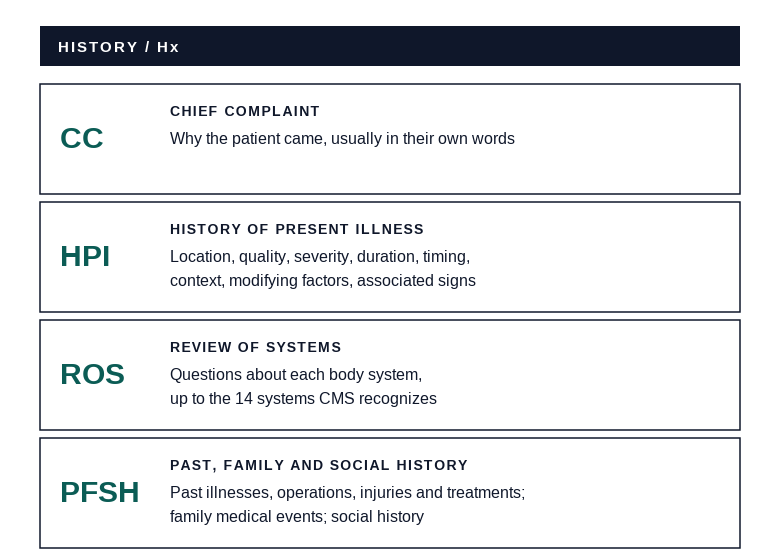
The abbreviations, part by part
| Abbreviation | Stands for | What goes in it |
|---|---|---|
| Hx | History | The patient’s background, generally; usually qualified |
| CC | Chief complaint | The reason for the visit, usually in the patient’s own words |
| HPI | History of present illness | The story of the current problem, from its first sign to today |
| ROS | Review of systems | Questions about symptoms, body system by body system |
| PFSH | Past, family and social history | The three background areas, taken together |
| PMH, PMHx | Past medical history | Earlier illnesses, injuries and treatments |
| PSH, PSHx | Past surgical history | Earlier operations |
| FH, FHx | Family history | Illnesses in the family, especially ones that may be inherited |
| SH, SHx | Social history | An age-appropriate review of past and current activities |
You’ll see the background abbreviations written both ways, PMH or PMHx, FH or FHx, for the same thing.
Chief complaint (CC)
The 1997 guidelines define the chief complaint as a concise statement of the symptom, problem, condition, diagnosis or other reason for the encounter, “usually stated in the patient’s own words.” It’s the shortest part of the note and the one every type of history includes. “Knee pain for two weeks” is a chief complaint. So is “here for a follow-up on blood pressure.”
History of present illness (HPI)
The HPI is the story of the current problem, told in order. The guidelines call it a chronological description of the illness from the first sign or symptom, or from the previous visit, to the present, and they list eight elements it can cover:
| Element | In a note it sounds like |
|---|---|
| Location | Right knee |
| Quality | Aching |
| Severity | 5 out of 10 |
| Duration | For two weeks |
| Timing | Worse in the morning |
| Context | Started after a long run |
| Modifying factors | Better with rest and ice |
| Associated signs and symptoms | Some swelling, no locking |
The guidelines split HPIs by how much of this they record. A brief HPI covers one to three elements. An extended HPI covers at least four, or instead records the status of at least three chronic or inactive conditions, which is how a follow-up visit for diabetes, hypertension and asthma can have an extended HPI without a single new symptom.

Review of systems (ROS)
The ROS is the part of the history that asks about everything else. The guidelines define it as “an inventory of body systems obtained through a series of questions seeking to identify signs and/or symptoms” the patient has now or has had. They recognize fourteen systems.
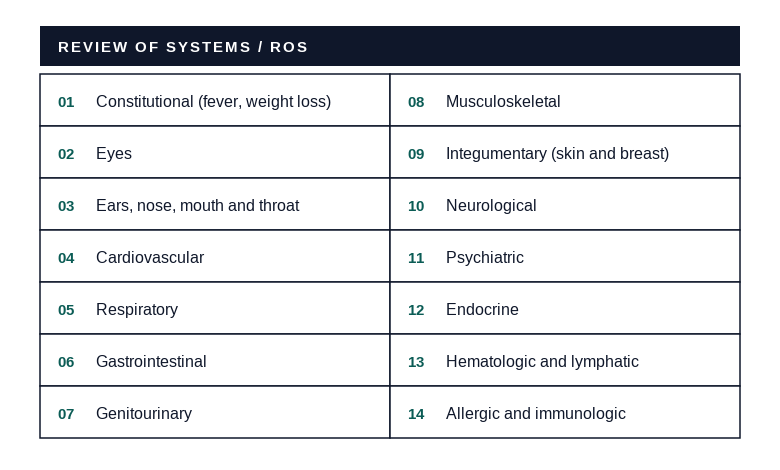
How many get asked about depends on the visit, and the guidelines name three sizes. A problem pertinent ROS asks about the system tied to the complaint. An extended ROS covers that system plus a few more, two to nine in all. A complete ROS covers at least ten. In a complete ROS the systems with positive findings or pertinent negatives have to be written out individually; for the rest, the guidelines allow a single line saying all other systems are negative. That line is why so many notes end their ROS with “all other systems reviewed and negative.”
A positive is a symptom the patient has. A pertinent negative is one they don’t have that matters to the question: no fever with a cough, no chest pain with shortness of breath.
Past, family and social history (PFSH)
The last part is three areas reviewed together:
- Past history: the patient’s earlier illnesses, operations, injuries and treatments. This is PMH and PSH.
- Family history: medical events in the family, including diseases that may be hereditary or put the patient at risk. This is FH.
- Social history: in the guidelines’ words, “an age appropriate review of past and current activities.” This is SH.

A pertinent PFSH records at least one specific item from any of the three areas, tied to the current problem. A complete PFSH records items from two or all three, depending on the kind of visit: an established patient in the office or a visit to the emergency department needs two, while a new patient or an initial hospital admission needs all three. Follow-up hospital visits that only take an interval history, the guidelines say, don’t need a PFSH at all.
Who writes it down
Not every line of the history is typed by the doctor. The 1997 guidelines allow the ROS and PFSH to be recorded by staff, or on a form the patient fills in, as long as the physician adds a note confirming or adding to it. A ROS or PFSH taken at an earlier visit doesn’t have to be repeated if the record shows it was reviewed and updated, with the date and place of the earlier version noted. And if no history can be taken at all, from the patient or anyone else, the note should say why.
How the four parts add up
The guidelines combine the three counted parts into four types of history. A chief complaint is part of every one.
| Type of history | HPI | ROS | PFSH |
|---|---|---|---|
| Problem focused | Brief | Not required | Not required |
| Expanded problem focused | Brief | Problem pertinent | Not required |
| Detailed | Extended | Extended | Pertinent |
| Comprehensive | Extended | Complete | Complete |
What changed in 2021
For office and outpatient visits, these counts no longer decide the level of the visit. Under the CPT changes that took effect on January 1, 2021, the level of an office visit is chosen by the medical decision making involved or by the total time spent on the date of the visit, and the code descriptions now call only for “a medically appropriate history and/or examination,” according to the American Medical Association’s summary of the changes.
The parts haven’t gone anywhere. Notes are still organized as CC, HPI, ROS and PFSH, the abbreviations still mean what they meant, and the 1997 definitions are still the clearest statement of what belongs in each.
History in diagnosis codes
History also turns up in diagnosis coding, as its own codes. The official ICD-10-CM guidelines describe two kinds of history Z code. Personal history codes describe a past condition that no longer exists and isn’t being treated but could come back, so it may need monitoring. Family history codes are for a family member’s disease that puts the patient at higher risk. They sit in categories Z80 to Z87, and the guidelines allow them as secondary codes when the past condition or family history affects current care.
The abbreviations around the diagnosis itself, Dx, DDx and R/O, are on the DxHx reference, and the note structure the history sits inside is on our SOAP note page.