What Is a SOAP Note? The Four Parts and What Goes Where
SOAP is Subjective, Objective, Assessment, Plan. Where the structure came from, what belongs in each section, which abbreviations turn up in which, and the mistake that hollows out the third one.

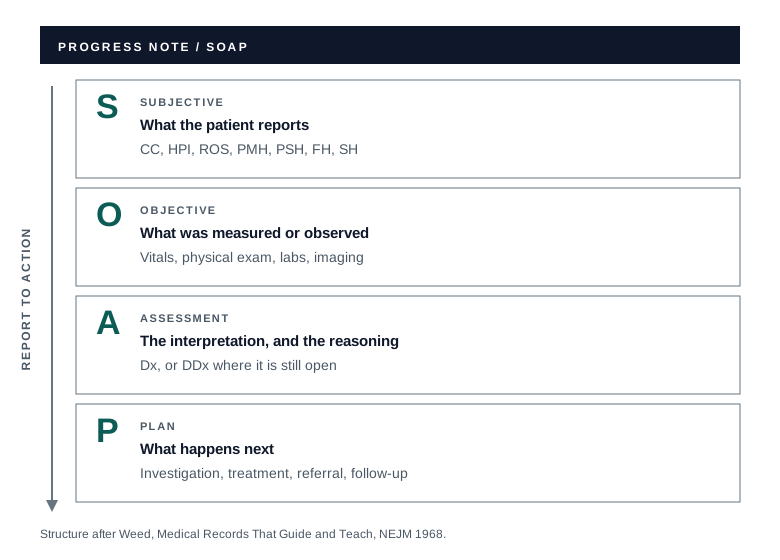
A SOAP note records a clinical encounter in four parts: Subjective, what the patient reports; Objective, what was measured or observed; Assessment, what the clinician concludes from those two; and Plan, what happens next. The order is deliberate, running from report through evidence to interpretation and action.
Knowing which section you are reading is also the fastest way to settle what an ambiguous abbreviation means, which is the practical reason this page exists.
Where did the SOAP note come from?
It came from one physician’s attempt to make a medical record behave like a scientific record.
Lawrence Weed published the idea in the Irish Journal of Medical Science in 1964, then in the New England Journal of Medicine in March 1968 as a two-part paper called “Medical Records That Guide and Teach”. His argument was that records organised by source, all the nursing notes here, all the lab results there, could not be reasoned from. He proposed reorganising the record around a defined list of the patient’s problems, with each entry structured so that the evidence and the reasoning were both visible and separable.
That system is the problem-oriented medical record, and it has two parts that outlived the rest of it: the problem list, and the SOAP note. Weed’s framing is worth keeping in mind, because it explains the shape. He was describing something closer to a laboratory notebook than a diary, where the point is that a later reader can follow how a conclusion was reached and disagree with it.
What goes in each section?
Subjective is the patient’s account. The chief complaint (CC), the history of present illness (HPI), the review of systems (ROS), relevant background such as past medical history (PMH), past surgical history (PSH), family history (FH) and social history (SH). Reported symptoms live here even when they are very specific, because the source is the patient rather than a measurement.
Objective is what was measured or observed. Vital signs, the physical exam, laboratory results, imaging. The distinguishing test is not how reliable something seems but who produced it: a patient saying they felt feverish is subjective, a recorded temperature is objective.

Assessment is the interpretation. The working diagnosis (Dx), or the differential (DDx) where it is still open, and the reasoning connecting it to what is above.
Plan is what happens next. Further investigation, treatment, medication changes, referral, follow-up interval, and what would change the plan.
What is the most common mistake in a SOAP note?
Writing an assessment that only restates the objective section.

An assessment reading “hypertension, diabetes, chronic kidney disease” is a problem list, not an assessment. It repeats known facts and contains no reasoning, so a reader learns nothing they could not have got from the chart header. The section exists to hold the part that is not recoverable from anywhere else in the record: what the clinician thought was going on, and why.
This has a documented tendency to worsen with electronic records, because a template that pulls the problem list forward automatically produces something that looks like a completed section without anyone having interpreted anything. The structure is intact and the content that justified the structure is gone.
The corresponding failure in the subjective section is copying forward the previous day’s history unchanged, which turns a record of what changed into a record of what was once true.
Does the order ever change?
Yes, and the variation is instructive.
Some electronic records present the same four sections as APSO: assessment and plan first, then subjective and objective. The reasoning is about reading rather than writing. A clinician opening a colleague’s note usually wants the conclusion and the plan immediately, and does not want to scroll through a review of systems to reach them. The content is identical; only the reading order changes.
Related formats exist for the same reason. DAP collapses subjective and objective into a single data section, which suits encounters where the distinction carries little weight. Some settings use BIRP for behavioural work. None of these replace SOAP so much as reorganise it for a particular kind of note.
How does the section tell you what an abbreviation means?
This is the part worth taking away.

Where an abbreviation has more than one meaning, position usually resolves it. PE is the clearest case in this reference: it is Physical Exam in an objective section and Pulmonary Embolism in an assessment. Both readings are common, neither is wrong, and the section is what separates them.
The same logic works more loosely elsewhere. An abbreviation in the subjective section is more likely to be about history or reported symptoms. One in the objective section is more likely to be a measurement, a lab or an exam finding. One in the assessment is more likely to be a named condition.
Context is a strong signal and it is not a guarantee. Where a reading is genuinely load-bearing and not obvious, write the word out. Several bodies maintain do-not-use lists precisely because some abbreviations are dangerous in writing regardless of where they appear, and local policy decides which are permitted in a record.
A note on what this page is
This describes how the SOAP structure is used in clinical documentation. It is not clinical guidance, it does not tell anyone how to treat a patient, and institutions differ on what their records must contain. If you are a patient reading your own notes, the person who wrote them is the right person to ask about them.
The full reference lists 80 codes by category, with the ones that carry more than one meaning marked.